
Air cleaners often get lumped into one bucket, whether they’re filters, purifiers, whole-house systems, or plug-in units. But these different products do not perform the same job. Some barely move the needle while others can change how your entire home feels.
The simplest way to compare a variety of air cleaners is with one number: the Clean Air Delivery Rate (CADR).
That number answers one of the most important questions: How much clean air does this “air cleaner” actually produce?
Our team at NW Energy Conservation is small, but we’re passionate about home energy efficiency and comfort. We’ve been serving the Seattle-Tacoma community for over a decade, helping both home and business owners to elevate their comfort and lower their energy bills. If you need help with anything HVAC related, don’t hesitate to reach out.
Clean Air Delivery Rate, often shortened to CADR, measures how much filtered air an air cleaner produces over a set period of time. Higher numbers mean the system delivers more cleaned air into the space.
CADR matters because air quality isn’t just about catching particles. It’s about cleaning enough air fast enough to benefit the entire space.
A product can sound impressive and still have a low CADR. This is why CADR is one of the clearest ways to compare options at the bottom line.
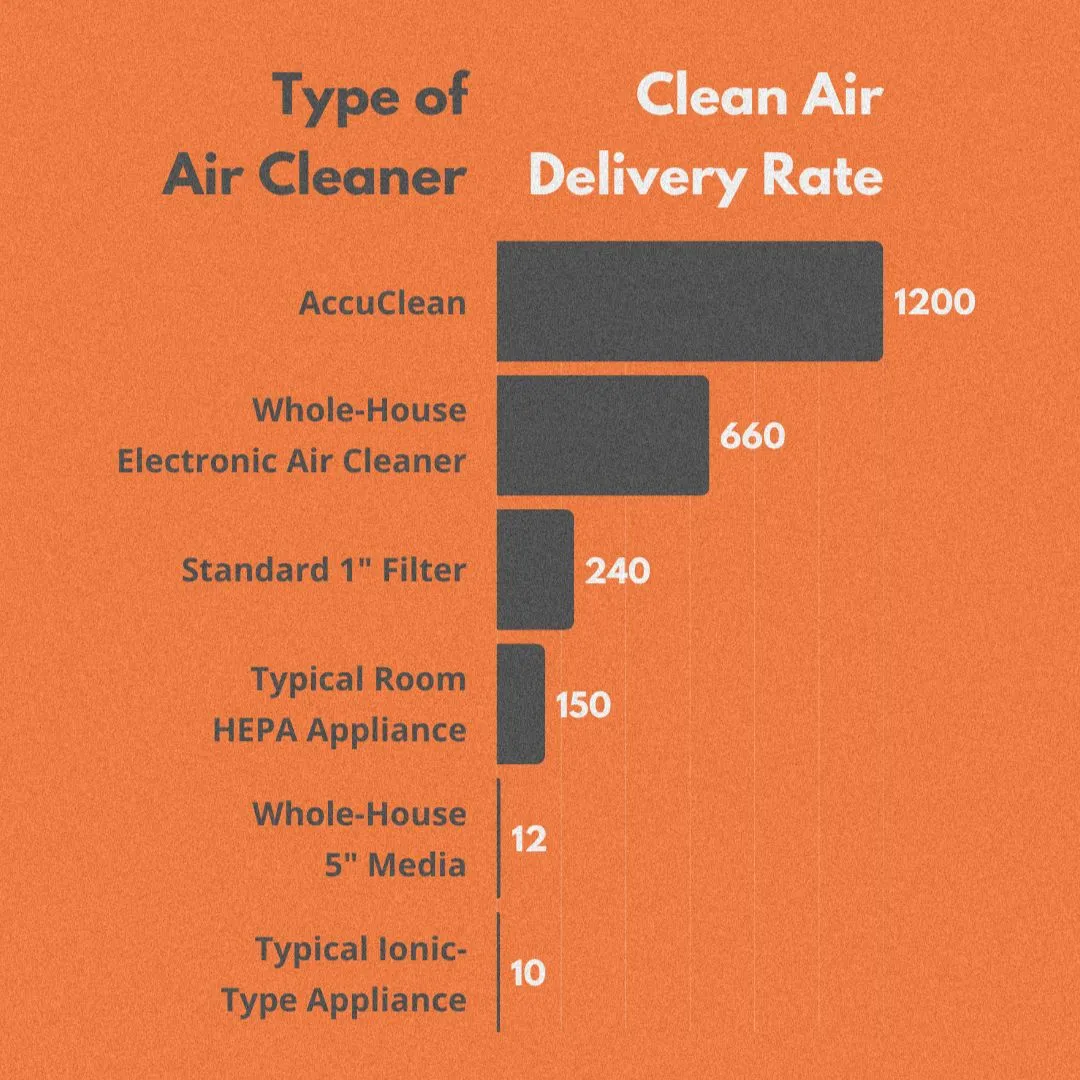
Here is a comparison of the CADR of some of the most common types of air cleaning you have available to you:
As you can see, some of these rates aren’t even close. There are entirely different levels of air cleaning that you can get for your home, so it’s important to know what you’re really getting for yourself.
AccuClean sits at the top of this list for one clear reason: Output.
A CADR of 1200 indicates the system delivers a very high volume of cleaned air across the home. This is the kind of number that can make a noticeable difference, especially for homeowners dealing with heavy dust, persistent allergens, or smoke concerns.
Whole-house solutions with high CADR work in the background. Every time air circulates through the HVAC system, the air cleaner does its job again.
That repetition is what makes whole-home air cleaning real, not gimmicky.
A CADR of 660 is still a serious level of air cleaning. It’s the kind of output that can keep up with daily living.
This category can help homeowners who want more than basic filtration but may not need the highest-output system on the market.
For many Washington homes, whole-house electronic air cleaners land in a practical middle ground. Strong results. Continuous cleaning. System-wide coverage.
Standard one-inch filters are the most common setup in residential HVAC systems. A CADR of 240 shows that they do filter air, but at a limited level compared to whole-house cleaners that you could install.
These filters primarily exist to protect equipment. They capture a portion of the airborne particles moving through the system, but they aren’t designed to aggressively clean indoor air.
A standard filter can support better air quality, but it shouldn’t be mistaken for a true purification strategy.
Portable HEPA units are popular because they’re simple. Plug in, turn on, feel productive.
A CADR of 150 can help in a single room, like your bedroom, office, or nursery. But portable units like this don’t clean the whole house unless you buy multiple units and run them consistently. Even then, they’re still localized and only help where they are.
At the end of the day, single room HEPA appliances can be a good supplement, especially for sensitive sleepers or households that want extra cleaning in one key space.
This is where homeowners often get surprised.
Five-inch media filters get pitched as a major indoor air quality upgrade. They can last longer than a one-inch filter, and they can capture more over time, but their actual CADR number shows something really telling: a CADR of 12 is very low.
This doesn’t mean they’re useless. It means they aren’t a high-output air cleaner. They’re more of a long-life filtration component than a true air cleaning system. They filter what passes through, but they don’t deliver cleaned air at the scale of electronic air cleaners.
Many homeowners buy these expecting purifier results, but their expectation often falls short.
Ionic-type appliances can sound like the advanced, modern, and powerful choice, but a CADR of 10 tells you the truth: these units deliver a very small amount of cleaned air.
In real homes, that output often fails to keep up with everyday sources of particles, dust, and allergens. Especially in larger rooms, open layouts, or multi-level homes.
If a homeowner wants noticeable whole-home improvement, systems with a CADR of 10 will rarely deliver it.
Homes are messy environments.
People cook. Pets shed. Shoes track in dust. Windows open. HVAC systems cycle. Outdoor air enters. Indoor air recirculates…. You get it.
Air cleaners have to keep up with that movement.
A low CADR system can technically “clean air,” but not fast enough to change the actual, consistent quality of the space. Higher CADR systems can keep pace with how homes actually behave on a day-to-day basis.
The best air cleaner depends on what you want to accomplish.
Consider which of the following goals matters most to you:
Portable options can help targeted rooms. Standard filters help baseline filtration. High-CADR whole-house systems help the entire home.
CADR helps you match the tool to the goal, instead of buying based on packaging or clever marketing.
Clean Air Delivery Rate measures how much filtered air a system produces over time. Higher numbers mean more clean air moves through the home.
Air cleaning only works if enough air gets cleaned. Low output systems cannot keep up with daily air movement inside a home.
Higher output helps with whole-home air quality. Smaller needs, like a bedroom, may not require the highest numbers.
Standard one-inch filters protect HVAC equipment. They remove some particles but do not clean air aggressively.
Portable HEPA units help in single rooms. They don’t clean the entire home unless used in multiple spaces.
Whole-house systems clean air every time the HVAC system runs. This repeated cleaning makes a noticeable difference.
Five-inch media filters last longer than standard filters, but they filter air slowly and don’t actually deliver high volumes of clean air.
Ionic-type units move very little clean air and their impact is often limited when compared to other options on the market, especially in larger homes.
Start with the problem you want to solve. Then match the system’s output to the size and layout of the home and your needs.
No. Airflow efficiency within your home or business directly affects how well any air cleaner performs. Poor airflow limits results, no matter what system you use. Reach out to our team to evaluate airflow and make any necessary adjustments to improve the overall efficiency and comfort of your space before an air cleaner is installed.
We don’t start with a product. We start by inspecting your space and addressing your needs.
We look at:
Then we recommend an air cleaning setup that fits both your space and your goals. The right solution is the one that delivers real clean air, at a rate that matches your life.
If you’re comparing air cleaners and feeling unsure, that’s normal. Reach out to NW Energy Conservation for an indoor air quality evaluation and we’ll help you understand what your home needs and what will actually deliver results.

.png)